Abstract
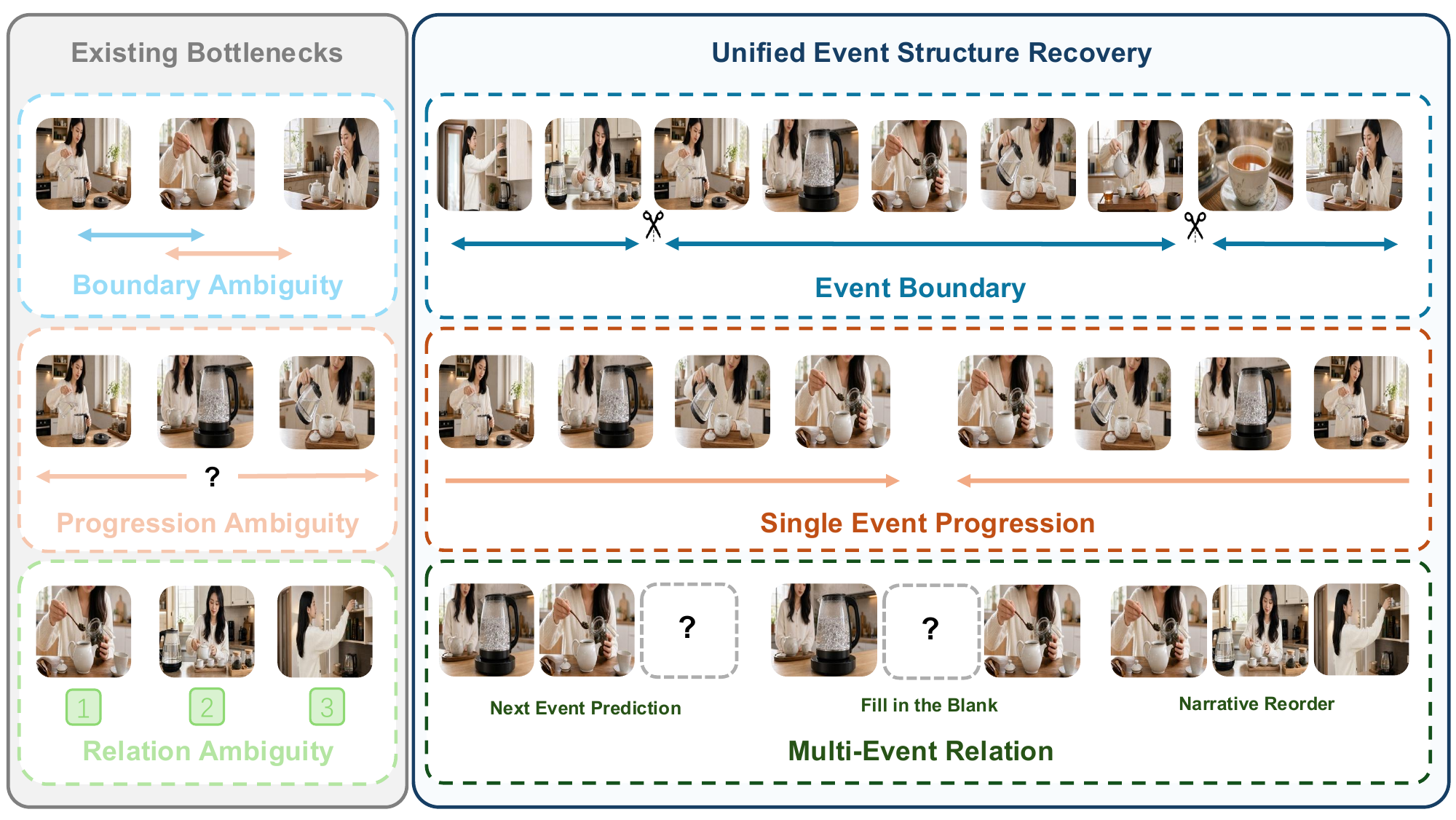
Recent multimodal large language models (MLLMs) achieve strong results on video question answering, yet often fail to recover the temporal structure that makes a video coherent. They may merge neighboring events, miss single-event progression, or infer implausible relations across events. We study structured temporal understanding as the ability to recover event structure from visual evidence, including event boundaries, single-event progression, and multi-event relations. We argue that this gap arises from a mismatch between current post-training objectives and temporal reasoning, where caption-style supervision allows models to rely on language shortcuts rather than visual temporal grounding.
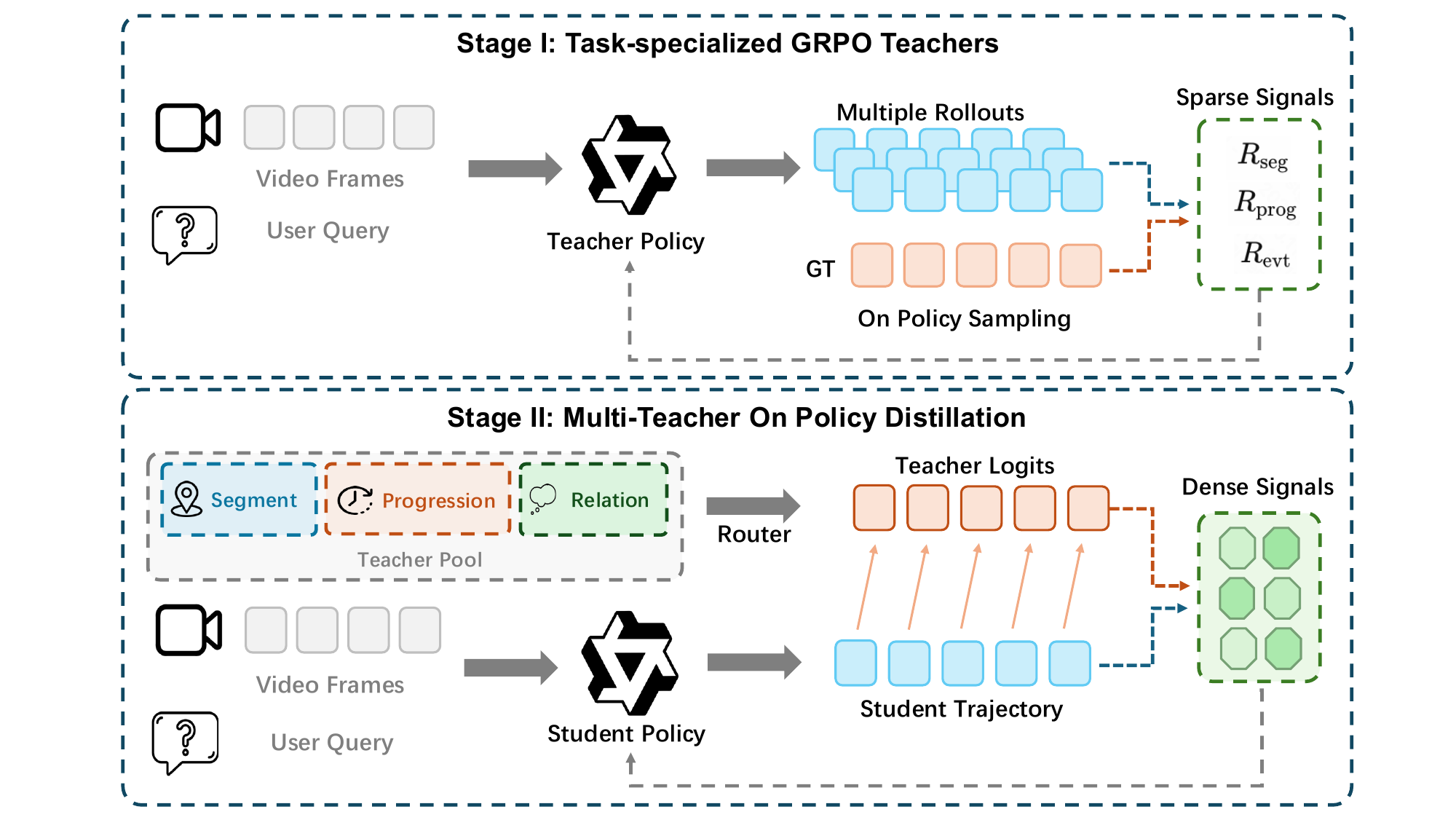
To address this, we propose EventLens, a vision-centric reinforcement learning framework that learns video understanding through event-structure recovery. Instead of reconstructing captions, EventLens trains models to recover temporal structure under controlled perturbations, such as altered temporal granularity, reversed progression, and shuffled event order. We instantiate this framework with a three-level temporal ontology and derive three verifiable task families: event segmentation, progression discrimination, and multi-event relation reasoning. These tasks admit deterministic rewards, enabling task-specialized GRPO training without human preference labels or learned reward models. We further introduce multi-teacher on-policy distillation (MT-OPD) to consolidate specialized policies into a unified model. Experiments on Qwen3-VL backbones show consistent improvements on temporal grounding and event-sensitive reasoning benchmarks, while preserving general video-QA performance. Learning curves further demonstrate that EventLens achieves comparable downstream transfer with significantly reduced training cost compared to direct mixed RL optimization.
Overall Contributions and Illustration
We introduce EventLens, a vision-centric reinforcement learning framework that learns video understanding through event-structure recovery. Our contributions are:
- Event-structure recovery as a unified target. We formulate structured temporal understanding as event-structure recovery from visual evidence, unifying event boundaries, intra-event progression, and inter-event relations.
- Vision-centric reinforcement learning. We propose EventLens, a vision-centric reinforcement learning framework that learns video understanding through temporal perturbation and recovery with verifiable rewards.
- Specialization and multi-teacher distillation. We introduce a training paradigm with task-specialized GRPO and multi-teacher on-policy distillation (MT-OPD), enabling stable integration of heterogeneous temporal skills.
- Temporal transfer and training efficiency. We demonstrate consistent improvements on temporal-structure benchmarks with controlled retention on general video QA, and improved training efficiency compared to direct mixed RL optimization.
Experiments
Temporal Grounding and Complex Reasoning
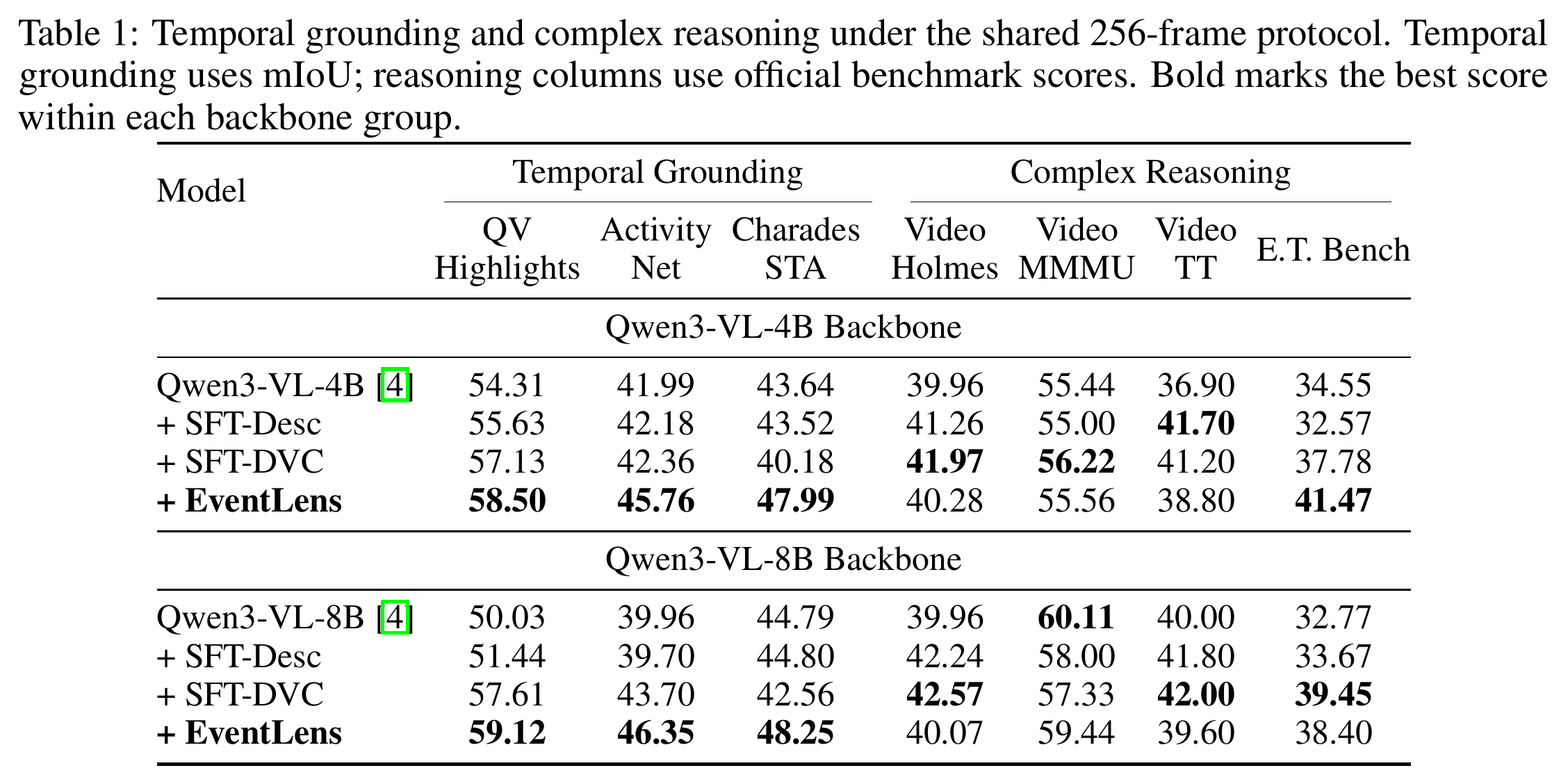
EventLens achieves the best temporal-grounding scores across both Qwen3-VL backbones. Reasoning gains concentrate on event-sensitive benchmarks such as E.T. Bench.
General and Long-Video QA
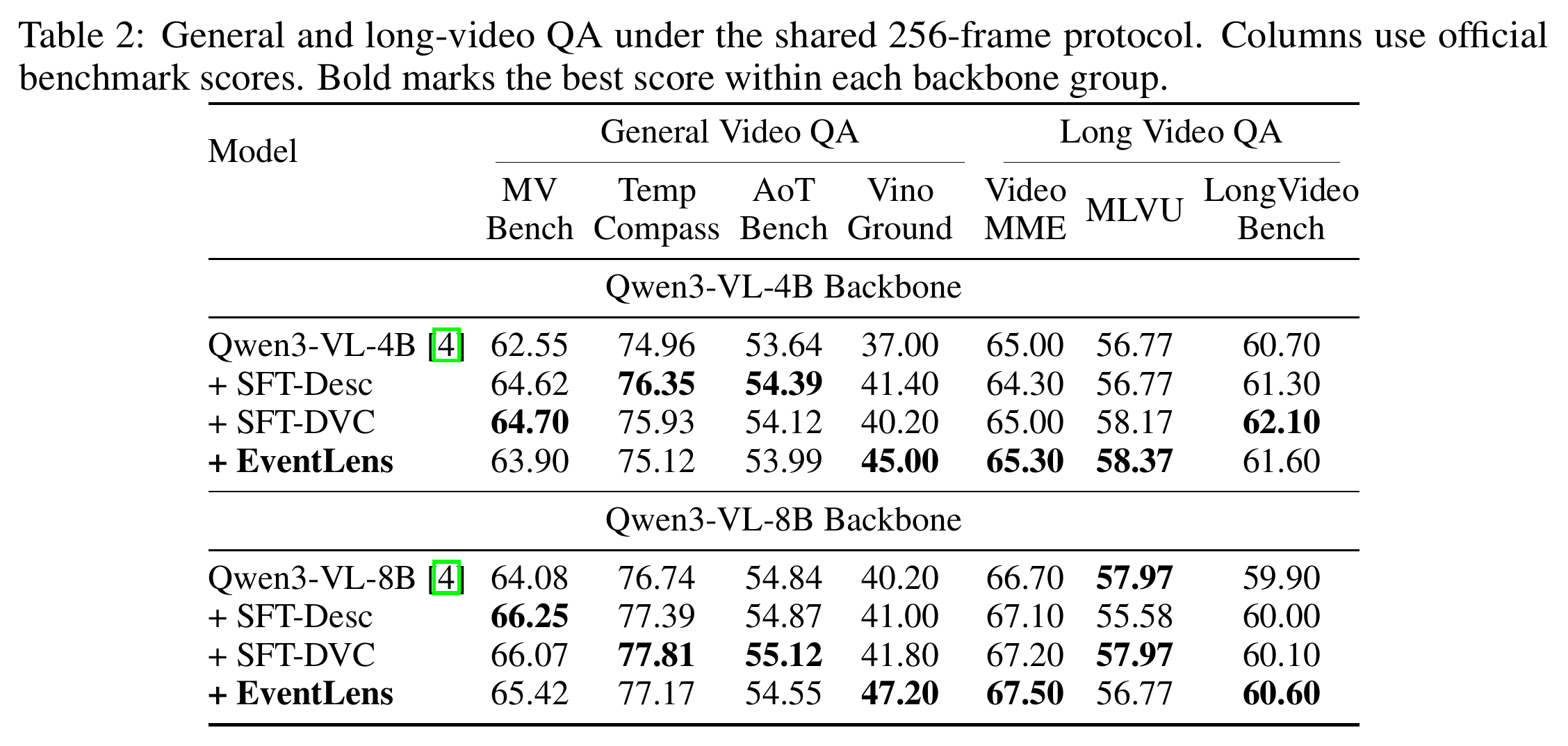
EventLens preserves comparable broad video-QA performance while improving event-sensitive reasoning. VinoGround gains 8.00 points at 4B and 7.00 points at 8B over the instruction base.
Ablation & Analysis
Teacher Specialization and Consolidation
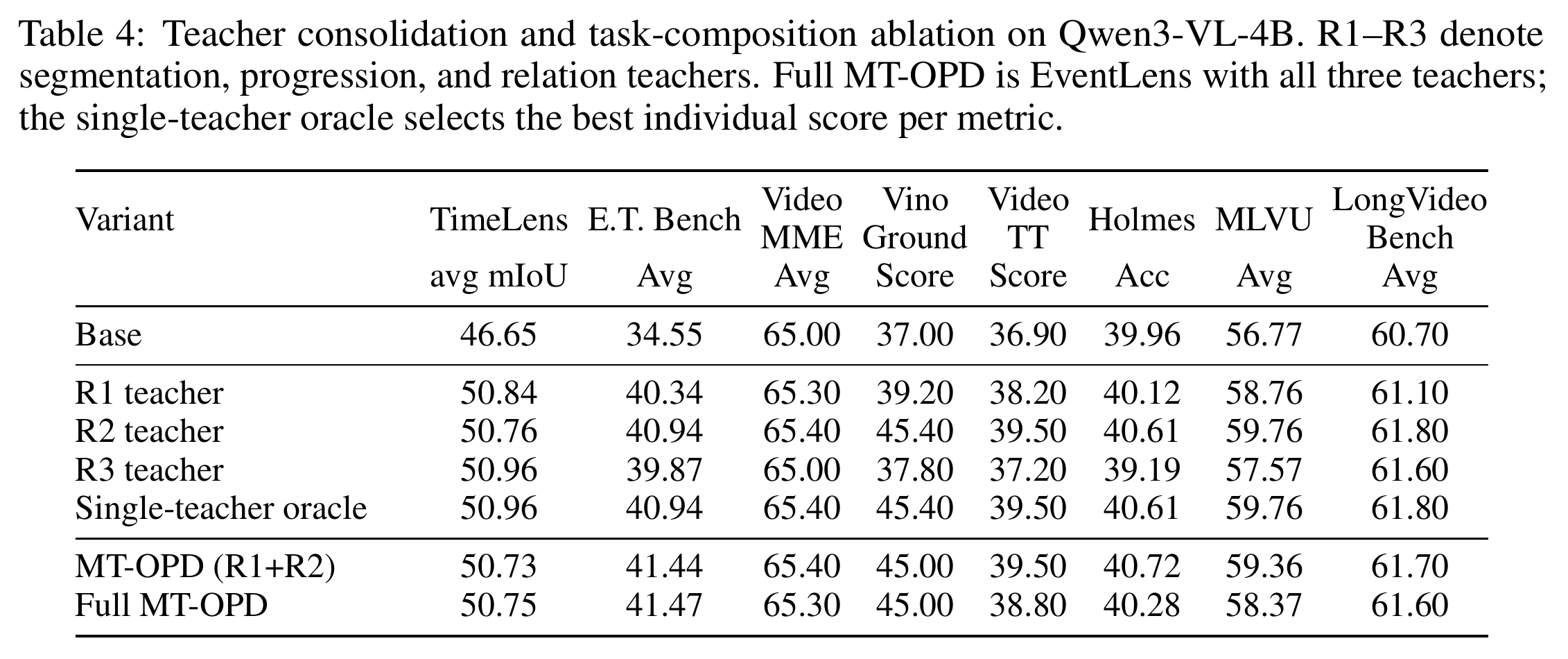
No individual teacher is best on every benchmark. MT-OPD consolidates their complementary strengths into one student, recovering most of the single-teacher oracle envelope.
Supervision Robustness
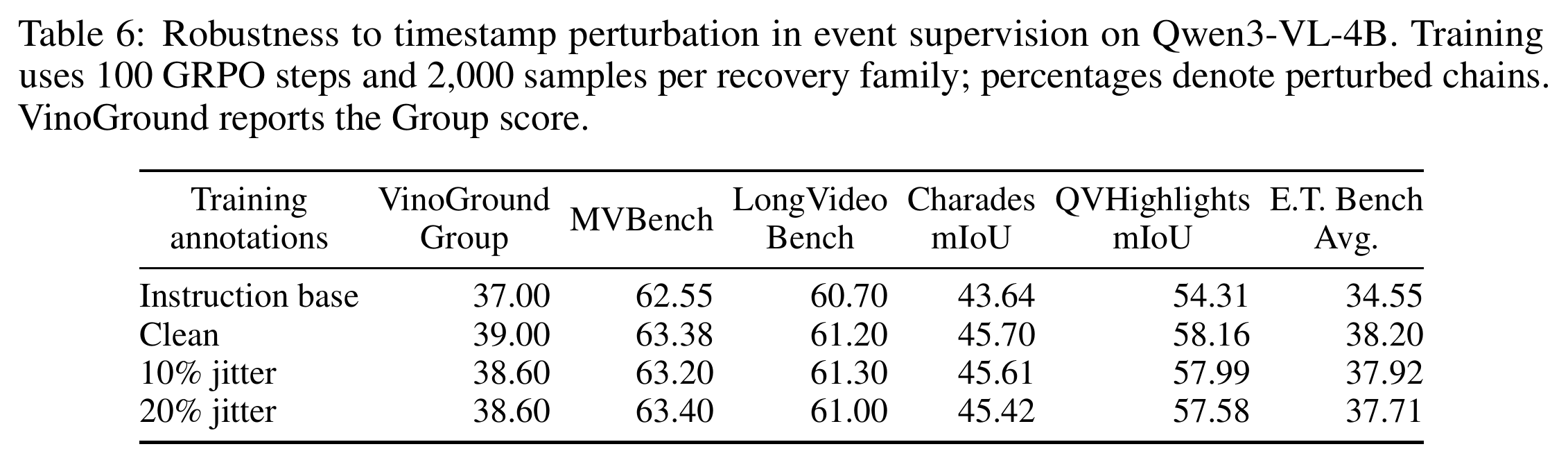
With 20% timestamp perturbation, all six metrics remain above the instruction base and close to clean training in the 100-step pilot. The gains persist under moderate noise in automatically reconstructed event supervision.
Training Efficiency
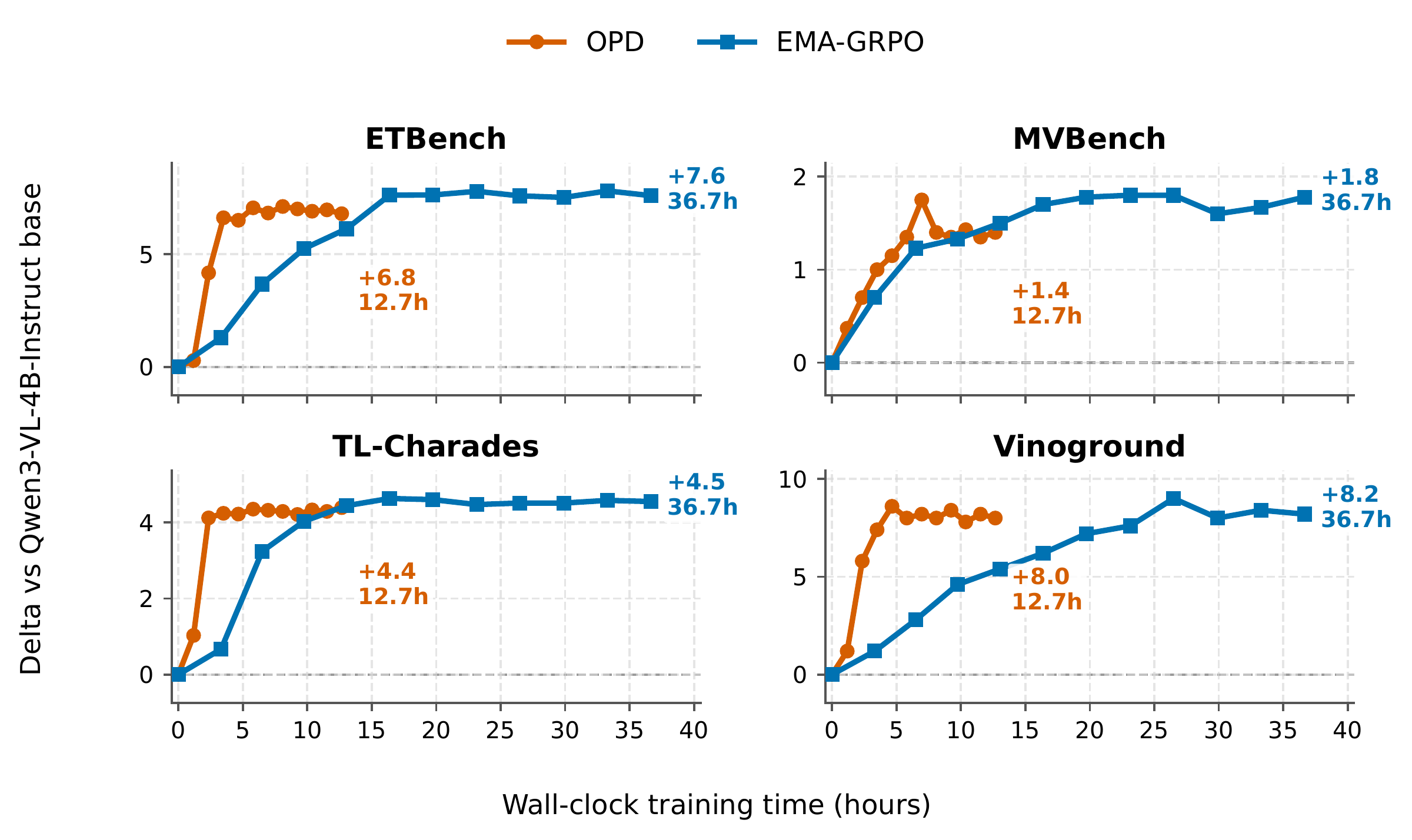
MT-OPD reaches a comparable downstream transfer regime after roughly 13 hours, while direct Mixed-GRPO needs roughly 37 hours. This comparison measures student-stage optimization; specialist-teacher training time is excluded.
Training Data
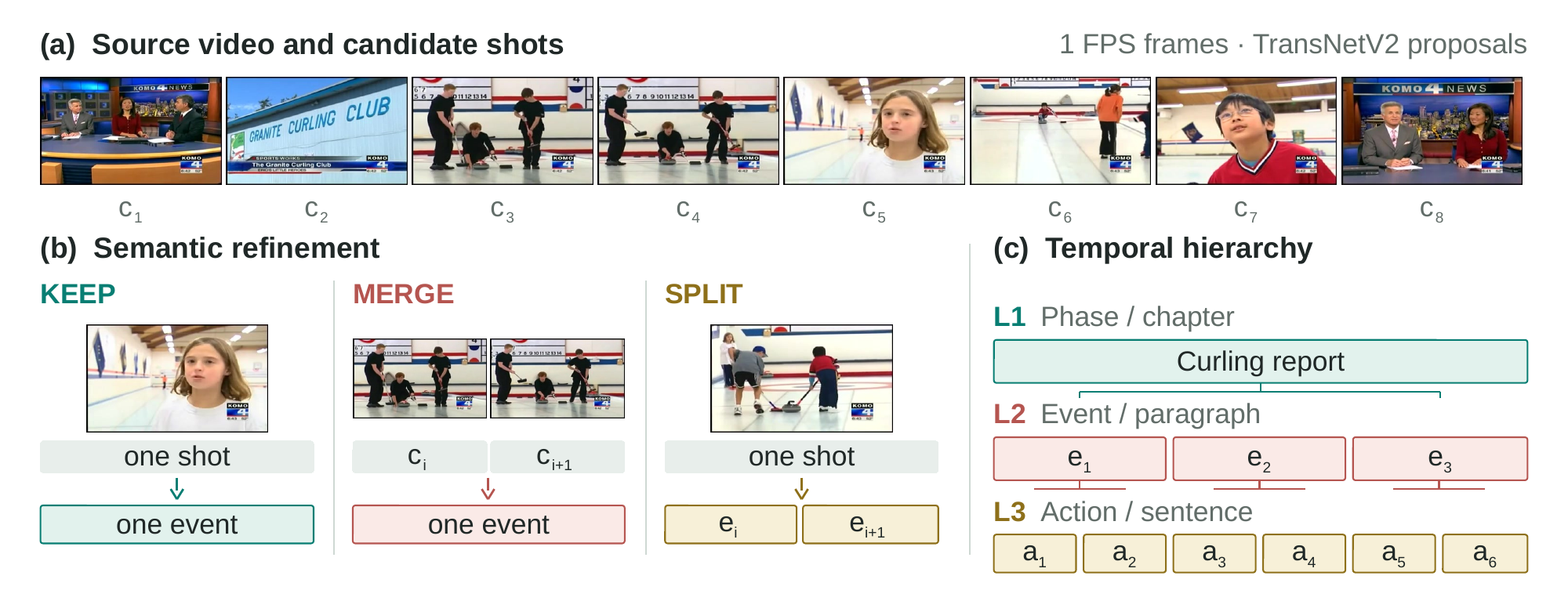
A shared event hierarchy supports complementary recovery tasks.
Temporal grounding and video QA provide additional training signals.
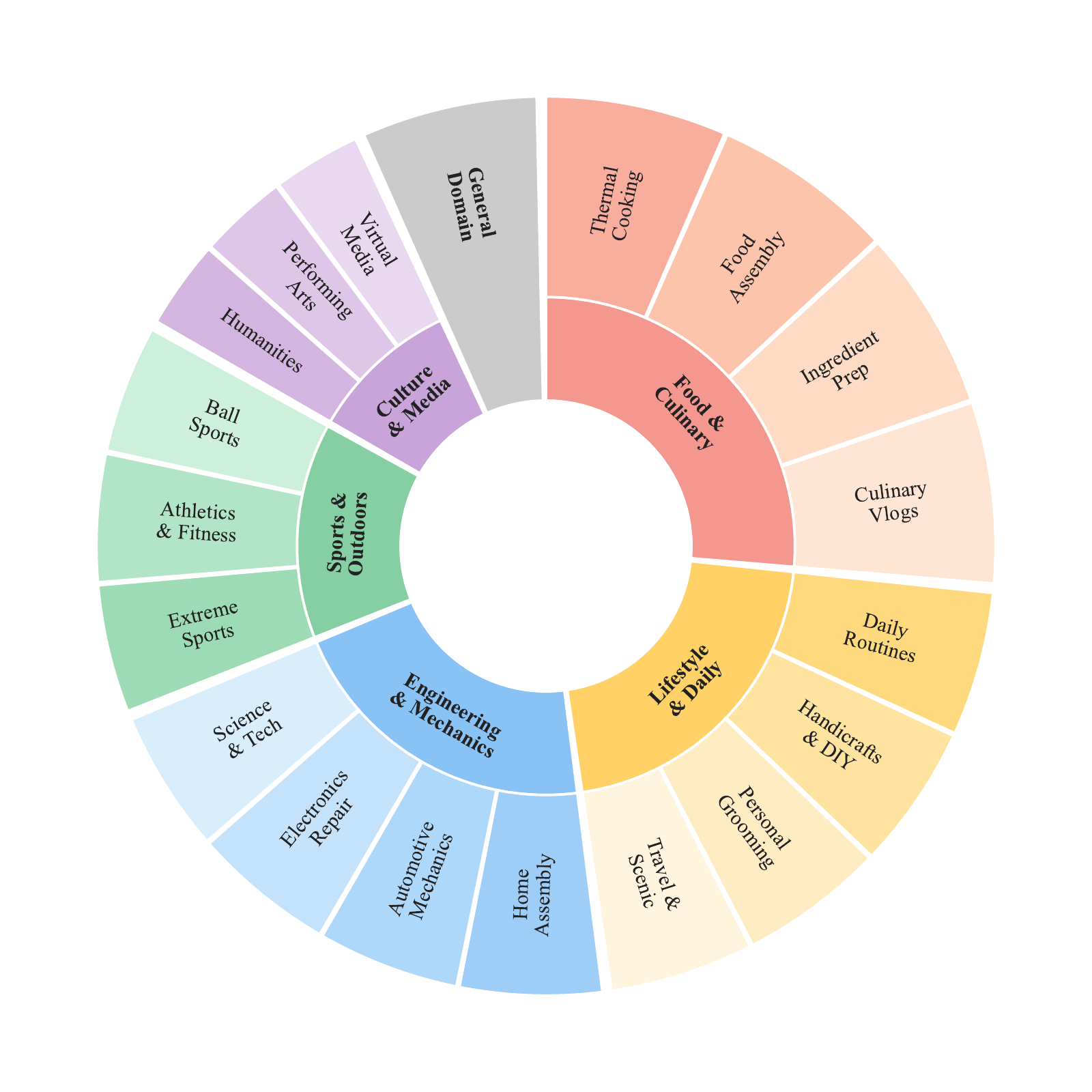
Download the training dataset and the EventLens-4B / EventLens-8B student models.
Demo Cases
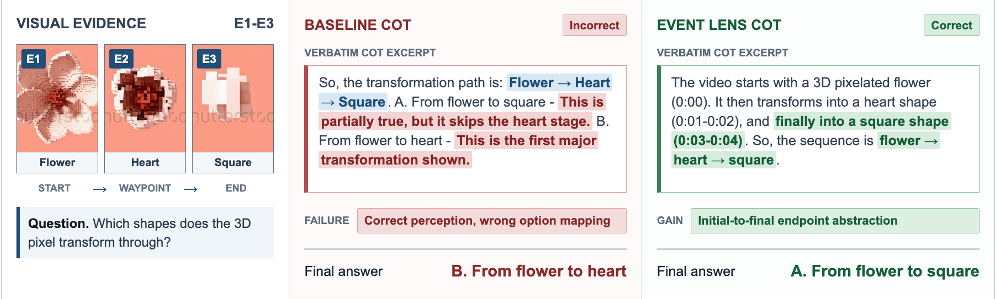
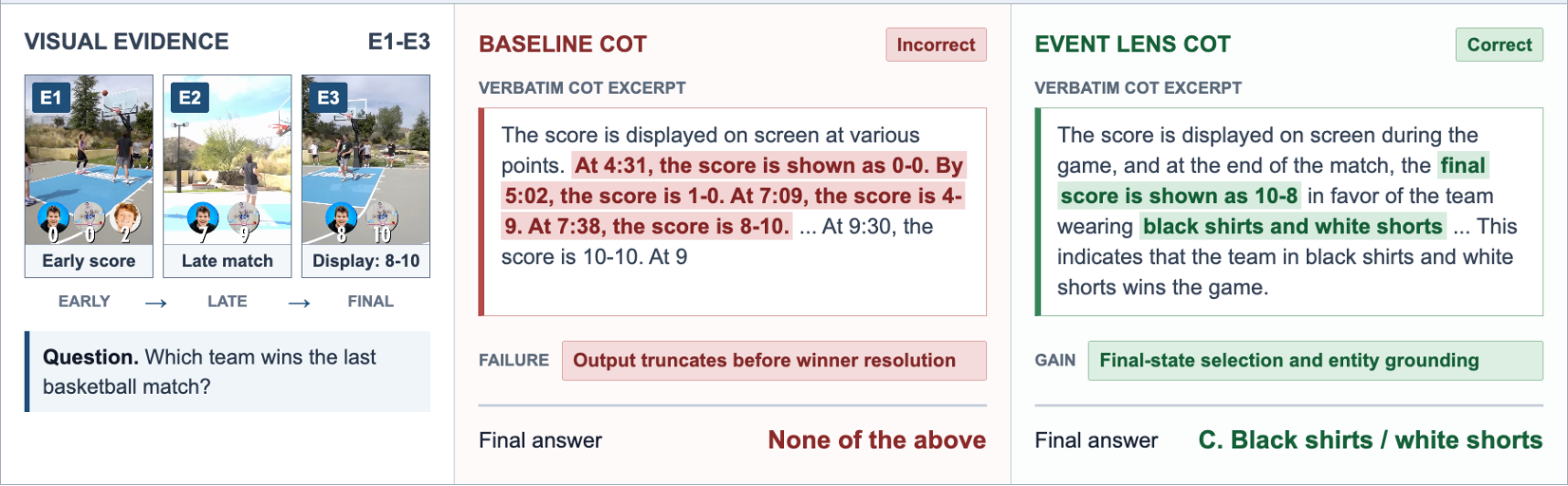
Qualitative examples of event progression and final-state reasoning.